
The enterprise AI landscape is rapidly shifting from generation to rigorous governance, context, and ROI. We don’t have a lack of AI tools or data, we have a lack of systems thinking, clear prioritization, organizational context, and stewardship.
I recently attended the AI Conference in San Francisco, and I left with a lot on my mind. As we help organizations design scalable human-AI workflows at Lini, here are the four key shifts on my mind:
1. Treat Agents Like Workforce Roles, Not Software Feature Sets
Access to information is not understanding of information. AI agents inherently see only what is above the waterline—they lack past intent, organizational memory, and subtle human nuances which can cause negative business consequences.
When Air Canada’s customer service chatbot mistakenly promised a passenger a retroactive bereavement discount, the airline attempted to defend itself in court by arguing the chatbot was a “separate legal entity responsible for its own actions” (Moffatt v. Air Canada, 2024). The tribunal rejected the defense as absurd and ordered the airline to pay. Courts and customers will treat an agent’s output as an authorized employee statement, regardless of whether you staffed a human manager to monitor it.
If we want agents to execute effectively across complex operations, we need to “GraphRAG” our human systems and governance structures just as carefully as our technical ones.
Give every agent:
Scope: Clear boundaries around what it can and cannot see, do and execute.
Explicit Context: Deep visibility into organizational history and goals. No “garbage in, garbage out.”
A Dedicated Human Manager: A clear line of accountability.
If no single human is accountable when an agent strays, your governance framework is broken.
2. Don’t Let AI Grade Itself, Start with Human-Calibrated Trust
As enterprise workflows transition from deterministic rules to probabilistic intent, the winning operating framework isn't "police the actions," but rather: "Police the rules, coach the intent."
There is a current federal class-action litigation against UnitedHealth Group over its nH Predict algorithm (Estate of Lokken v. UnitedHealth Group - 2023). The insurer used the model to evaluate patient care needs and issue coverage cutoffs, effectively letting an uncalibrated algorithmic judge override human doctors. When denied claims were eventually escalated to human appeal panels, the algorithmic decisions were overturned 90% of the time. Deploying automated evaluators without calibrating against baseline human agreement doesn't eliminate bias or error, just hides it until a regulator, auditor, or plaintiff exposes it.
Trust requires continuous calibration. You wouldn't hand total operational control to a new hire on day one without clear scope, onboarding context, and regular check-ins—so why treat AI agents any differently?
Relying blindly on an LLM-as-a-Judge without first calibrating baseline human agreement creates dangerous hidden variance. Building safe, durable AI systems requires:
Deep visibility into execution pathways.
Direct analysis of raw logs and traces.
Embedded real-time evaluation frameworks.
A reliable "Control-Z" - rewind mechanism for swift intervention when an agent drifts.
3. Cost Per Outcome > Pure Token Cost
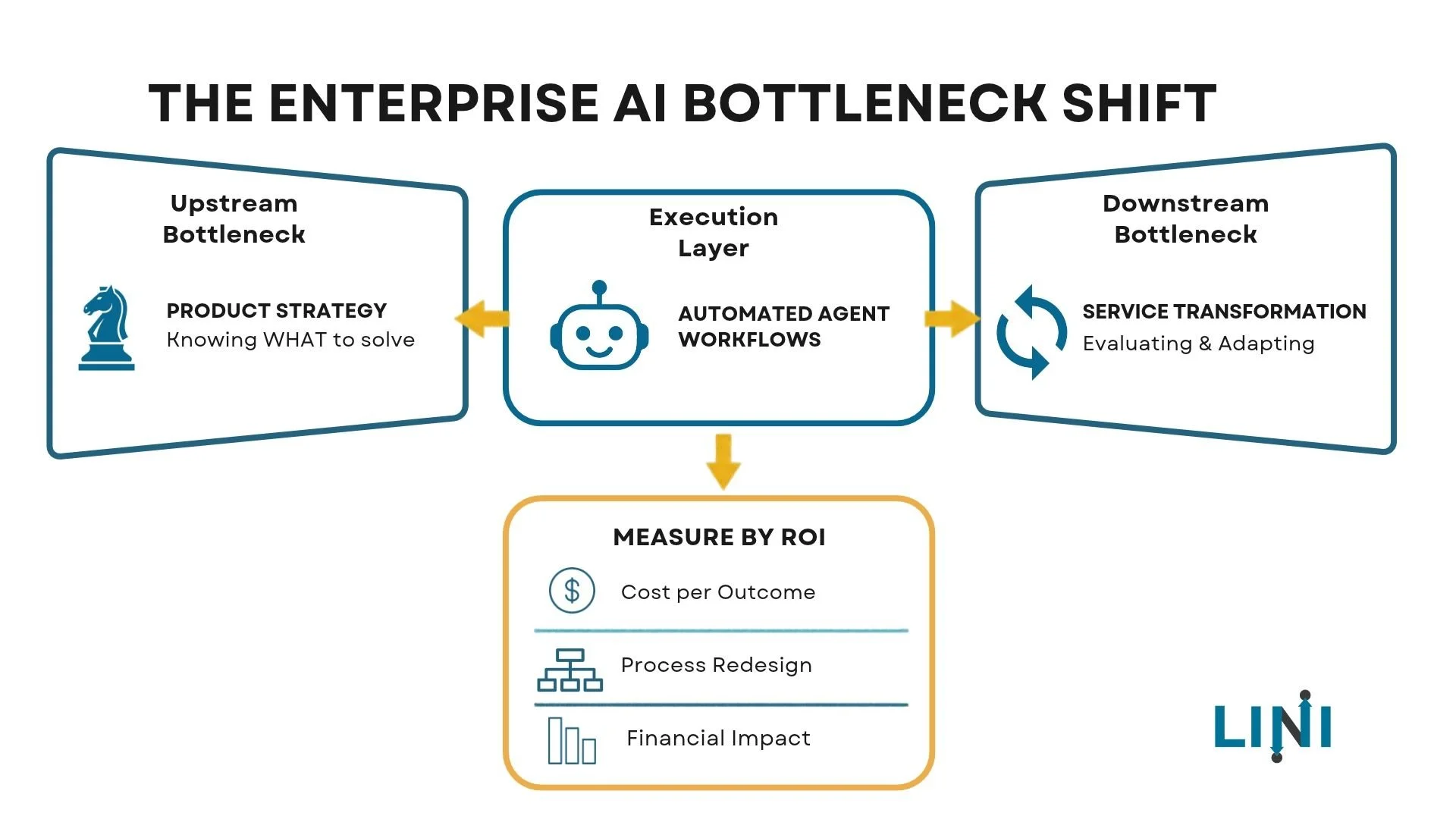
Automating execution shifts structural bottlenecks in two primary directions:
Upstream Bottleneck: Product Strategy (knowing what to solve and why)
Downstream Bottleneck: Service Transformation (change management, evaluative measurements and adoption)
According to BCG and McKinsey, over 70% of enterprise AI pilots stagnate due to unclear success criteria and unproven ROI rather than technical limitations. High-performing organizations don't measure success by vague "time savings" or baseline token efficiency. Instead, they link specific agent workflows directly to financial metrics, unit economics, and fundamental process redesign. Without fundamental workflow transformation, automation merely masks systemic bottlenecks until they compound into far more expensive failures.
When Klarna deployed its customer service agent in 2024, they ignored raw token expense and measured a single downstream outcome: cost per resolved interaction. By redesigning the service workflow from scratch, the system absorbed two-thirds of all customer inquiries, cut resolution times from 11 minutes to under 2 minutes, and drove an estimated $40 million annual profit improvement.
4. Data Sovereignty in Motion
Traditional data security models were built with static architectures in mind. They address data strictly at rest. Agentic workflows disrupt this model by putting data in continuous, autonomous motion across global enterprise ecosystems.
Recent security audits of multi-tool workflows (like Slack AI) proved that when an agent has the autonomy to query internal databases and trigger external APIs, a single indirect prompt can trick an agent into exfiltrating sovereign internal records across external boundaries. Also the wave of enterprises that had to abruptly pause rollouts of Microsoft 365 Copilot due to legacy perimeter controls. Additionally, the OpenAI and HuggingFace issue. If your compliance model only monitors where files sit on a disk, an active agent will bypass it every single time.
This dynamic state for data, introduces three critical safety vectors:
Human-to-Agent (Input & Intent)
Agent-to-Human (Output & Execution)
Agent-to-Agent (Cross-System Flow)
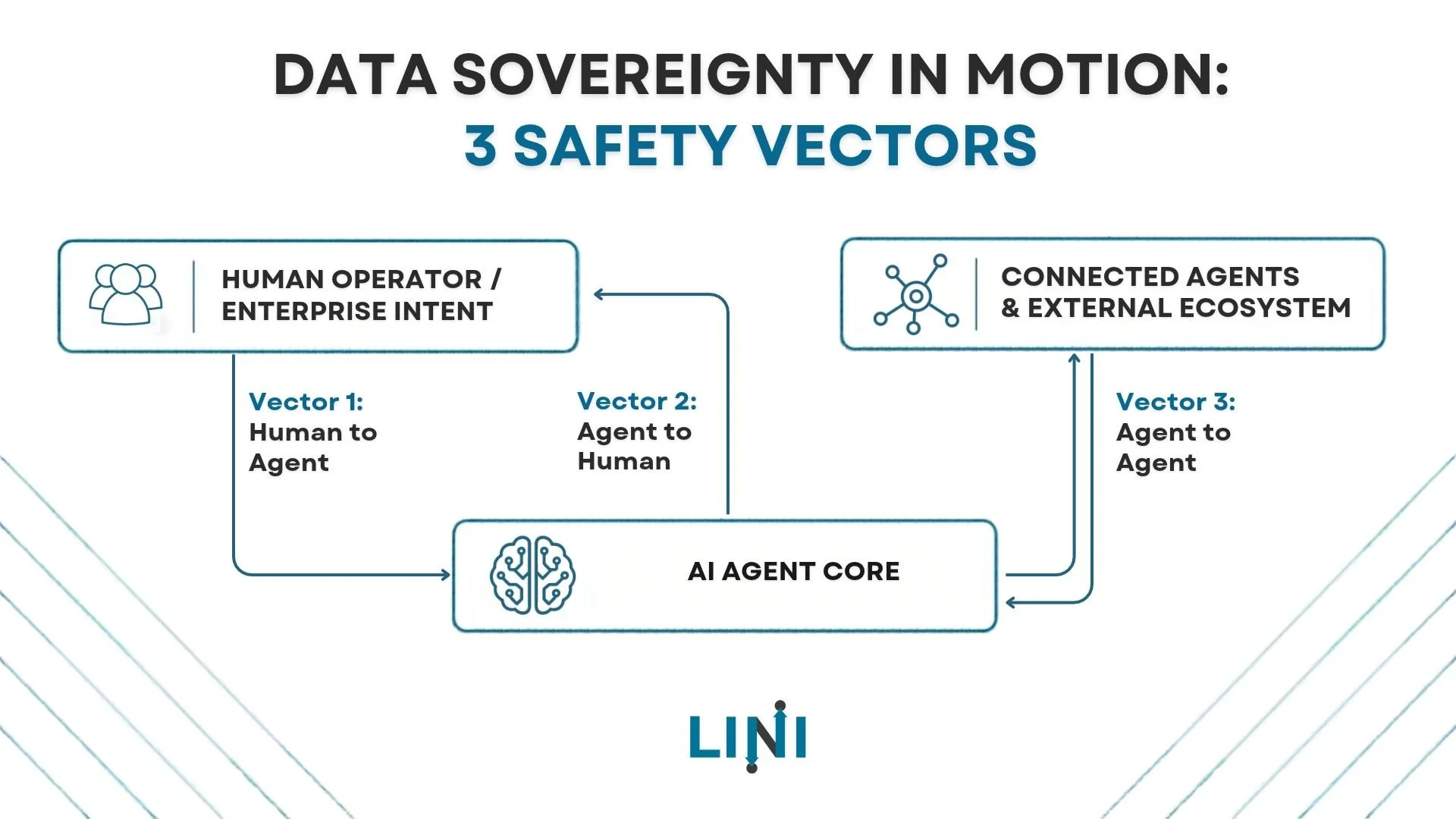
Protecting enterprise data in this new paradigm requires moving beyond legacy perimeter security to build intentional, real-time architectural guardrails around every active interaction layer. If your compliance model only monitors where files sit on a disk, an active agent will bypass it every single time.
Moving From Experiments to Durable Value
When we treat agent architecture with the same rigor we apply to organizational design—incorporating clear scopes, distinct identities, direct accountability lines, and auditable trails—we move past fragile pilots and build sustainable, enterprise-grade AI capability.

This article was written by Sylvia Bargellini
She is a creator of innovative human-centric products and services that enhance emerging technology process efficiencies, experiences and profits by identifying unique creative business opportunities. With over a decade of industry knowledge Sylvia guides interdisciplinary teams towards effective product optimization.